
Why Hand Recovery After Stroke Takes Time — How to Support It Gently

Hey Fam!
If your wrist or fingers are still not moving the way you hope after a stroke, I want you to know something first:
You’re not behind.
You’re not failing.
And you’re not doing anything wrong.
Hand and finger recovery is often one of the slowest parts of stroke rehabilitation — and there is a very real reason for that.
In this week’s video, I explain why this happens and how you can work with your brain instead of feeling frustrated by it.
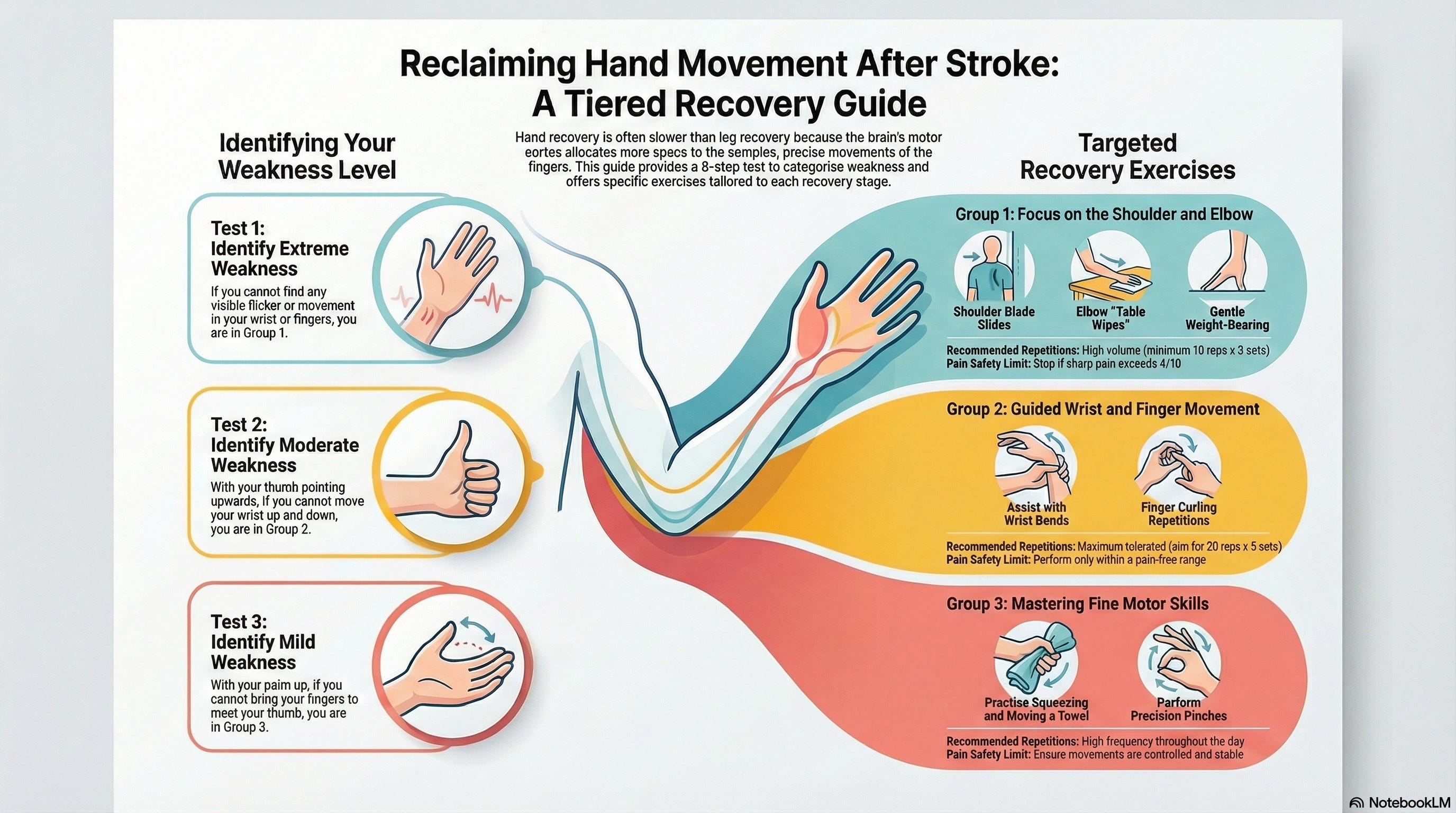
(Infographic is at the bottom)
Why the Hand Takes Longer to Recover
Inside the brain, the hand occupies a very large area of the motor cortex.
This is because:
The hand performs extremely precise movements
Each finger needs individual control
Small changes require very accurate brain signals
After a stroke, this detailed network is disrupted. Rebuilding it simply takes more repetition and patience than larger movements like standing or walking.
This doesn’t mean recovery isn’t happening — it just means it’s happening more quietly.
Step One: Understand Your Current Strength Level
In the video, I guide you through three simple self-checks to help you understand where your arm currently sits.
You may fall into one of these groups:
Very weak movement — little or no finger or wrist control
Moderate movement — some motion but poor control or fatigue
Milder weakness — movement present but fine control is limited
This step matters because recovery should match your current ability, not someone else’s.
Matching the Exercise to Your Stage
If movement is very limited, recovery often starts higher up the chain:
Shoulder stability
Supported arm movements
Using gravity and assistance
If you have some wrist or finger movement:
Repeated opening and closing
Guided gripping
Controlled release practice
If movement is clearer:
Picking up small objects
Finger coordination tasks
Slower, more precise control exercises
Each level builds toward the next.
Why Repetition Matters So Much
The brain does not relearn movement through effort alone.
It relearns through:
Repetition
Consistency
Clear feedback
That’s why doing small movements many times — even if they feel unimpressive — is far more powerful than pushing hard once in a while.
Every repetition is a message to your brain:
“This movement still matters.”
A Gentle Reminder
Hand recovery is rarely linear.
This is normal.
What matters most is staying kind to your body while continuing to show up with calm, repeated practice.
👉 Watch the full video here to see the tests and exercises demonstrated clearly:
With kindness,
Basically Physio
P.S. If you or someone you care for feels discouraged by slow hand progress, this video may help explain why — and bring a little reassurance along the way.
P.s.s Here’s the downloadable infographic :
)